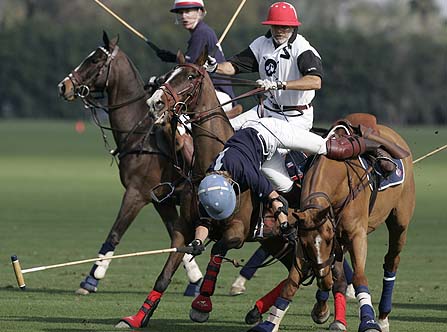
 Simply put, eject without a parachute. Bail. Get off quickly. This is the second thing that should be taught to everyone on horseback, right after learning how to get on one. I have saved a situation many a time with a simple dismount. You need to be comfortable with the quickest way off a horse and how to land in a manner to minimize the potential for injury.
Step 1 - Shorten your reins.
Step 2 - Kick your feet out of both stirrups (being dragged is not a good thing).
Step 3 - Discard any whip or mallet.
Step 4 - Pick which side is better to get off. Practice both sides.
Step 5 - Press against the horse’s neck with one or both hands.
Step 6 - Kick your leg over the horse in a vaulting motion. It is important to clear the rump of your horse.
Step 7 - Land off to the side of the horse, with your legs bent to absorb shock. You should be facing the side of the horse as you land onto your feet.
Step 8 - If you are at speed, be prepared to roll when you hit the ground.
If you ever watch snowboarders when they fall, they usually roll right back onto their board. It is sudden stops that will increase the impact. Strangely enough, when we are going fast, we are usually thrown into a roll naturally. Then we go down slowly, we put out a hand, or lock our knees and the result is a more serious injury.
Step 9 -Try to hold onto your horse if you land on your feet
Step 10 - If you are on the ground, be aware of additional traffic and clear out of the way if possible.
Use safety girths (overgirths), keep your tack in good repair, and always use large stirrup irons, thick stirrup leathers (buffalo leathers are very popular). Practice your emergency dismounts at a stand still initially and then maybe at a moving walk or trot with professional supervision. The better you are at it, the more familiar it will be when the time calls for reacting as opposed to thinking.
Photo: C. Beal
by L. Bremner