How often have we heard that wonderful line after a whistle? One teammate exclaiming to another, "No"?????, I thought you said, “Go”. And vice-versa. These two rhyming words have been the root of countless whistles and missed opportunities.
A polo field is the perfect setting for us polo players to practice our somewhat dysfunctional, yet colorful vocabularies. The terms on the field are supposed to offer direction and clarification. Unfortunately, at times, the direction may be accompanied by some inappropriate references to family heritage. In fact, sometimes the message is absent of any productive content whatsoever.
In the USA, often times it is an advantage for an umpire to not have any comprehension of a foreign language. What you can ‘t understand will never hurt you. But at times, a translation would provide immediate ejection from the remainder of the game. Have you ever noticed that swearing in Spanish or French seems to be absent of the hard edges of the same words pronounced in English? I guess that may be one of the reasons they are called the romance languages. Even swearing in those languages seems to carry a less offensive musical tone.
However, back to the subject at hand. What are the effective and ineffective commands for the field of play? In the beginning and novice stages, a great deal of field talk is imperative and extremely helpful. In the more advanced levels of play, the verbal direction is replaced by non-verbal anticipation. The teams operating at optimum levels seem to be plugged into some mysterious level of telepathy amongst the teammates. Any announcement of directives at this level can often be viewed as unproductive as the opponents are in attendance and receiving the same information. Pretty much like inviting the competition to your staff meetings. Sometimes, higher levels will use team talk as a deception. A teammate yells tail and draws a couple of defenders, which allows the teammate backing the ball to turn the ball into a less congested area. Four players on offense is usually better than three, A respected player once told me that any directive uttered from his lips was merely an option. He understood that sometimes the player in possession may see a better play, or the ball may be in a divot, not allowing for a strong pass down field.
But I will focus on the more novice level of play.
Here are the common directives:
Self Defining
Turn-it - Turn the ball
Hook - Your opponent
Center - Hit to the center
Hit it out - Hit over the boards/sidelines when your team is poorly positioned
Hurry
Take your time
Follow me - Come along in line behind your teammate with the ball to cover
Leave it - Don’t hit the ball-if a teammate has a better play
Stay up - Don’t turn back
Stay Back - Stay on defense
Left/right/under you -Locating the ball for a teammate
Productive
Open/Away-Hitting away from the horse from either side of the horse on backhanders
Tail-Hitting towards the horse and around behind from either side on backhanders
Boards-Hit towards the closest boards/sidelines
Hard/Clear-Hit hard
Hold it-Maintain possession of the ball until a teammate is open.
Take it with you/or Keep it-Keep it yourself
Take the man/man-that dreaded phrase everyone hates/keep your opponent from the ball
Go Back/Get Back-Get to defense
Go Up-usually means offense/go for a pass
Cover Goal-Try to block an upcoming shot on goal
Get around/Rotate-Turn back or rotate in behind the players going to the ball
Go to goal-may mean either for a pass or with the ball
Man coming-opponent coming from behind
Through-usually yelled if ball goes through the throw-in
Questionable
Hit it-That would seem obvious and certainly not much direction
You are all alone-can sometimes create tension as opposed to eliminating the same
Leave it-I put it here as well, as this directive can be very much abused
Look out/Get out of the way-both of these are better than running over someone
I will close with the final comment that you must be able to clearly project your information on an outdoor field on a windy day or in an arena with an enthusiastic crowd. A raised voice should be productive and positive, but the polo field is no place for softly spoken directives. Some people are sensitive to volume, but volume is necessary for someone to hear running around a polo field. However, because of the volume, your words should be either informative or positive. Public embarrassment and/or verbal abuse are two characteristics that have no place in any environment.
Happy Polo.

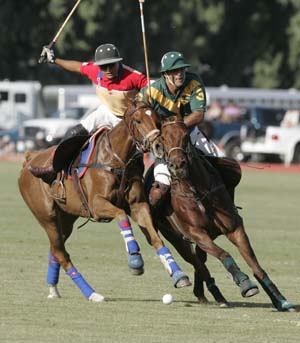 Tip 21- Proper Field Terminology- No ?? I thought you said Go !!