 Tip 38: The Throw-in - I struggle to think (I could end the sentence right here) of another sport that brings everyone together following a score and has the umpire throwing the ball in to the entire group. Kind of like throwing bread to seagulls and expecting a proper formation (mine-mine-mine for you Finding Nemo fans). Football may come close, but there are specified players to return the kick-offs or punts. Hockey and lacrosse both have two players facing off. But polo allows the possibility of any of the players to come up with the ball.
Polo also resumes play with a throw-in after every out of bounds and some whistles where no foul is the determination. Some infractions of procedure also are resolved with a throw-in, so it is rather obvious that throw-ins are a key factor in the play of the game. At the very least, it is a necessary evil.
1) The first piece of advice is to get to your position in the throw-in quickly. This may sound simple, but it is amazing how many times players are slow getting back to the throw-in. Save the victory celebrations for after the game, get back to the throw-in following goals. When balls go out of bounds, get to that area quickly so that you are ready. Instead of big long arcs back to the throw-in, plot a more direct course from where you are to your position in the throw-in. I know, it sounds pretty darn obvious, but…….direct line, less strides, less time, less wear and tear. One good example where less is more.
2) Get to your man in the throw-in. You may be forced to your nearside, but putting your opponent in your pocket and having a free side to stroke the ball is more effective than getting hooked. There are some cases where the abilities of the two opponents are not evenly matched, so at times, if you truly do have the quicker mallet and horse, you may choose to try to beat your opponent to the ball.
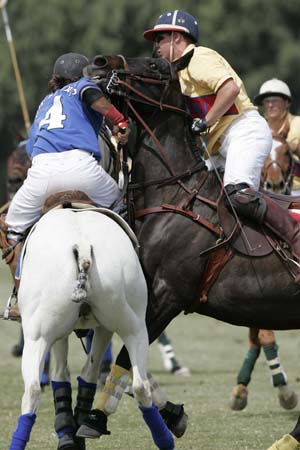
3) Watch your swings-You are not allowed full swings in close quarters, but it is usually just the more reckless ones that actually get called. Faces are down looking for the ball and players are in close quarters. A full hard swing in this situation screams potential trouble. So be aware-be very aware of your face, your opponents, and all of the horses.
Generally, the number ones are supposed to try to turn down field for a pass and at the same time hold the opposing number one from getting loose to quickly. If you do get the ball, you should probably bring it to the boards or sidelines first, get your momentum going and then either release the pass or take it yourself. A quick neck shot out of the throw-in is usually a turnover to the other team.
The number four players outdoors and the number three players in the arena usually line up a little more defensively. They sit out to the side about five to twenty feet and at a slight angle to stop any fast breaks. The angle also allows them to turn back to the ball quicker if the ball goes all the way through.
If the umpire is following the book to the letter, they will not throw-in the ball unless both teams are on their proper sides. However, there can be a lot of grey matter here. Some umpires improvise a bit and will throw the ball in quickly, catching unprepared players off balance. They may wait too long and put the teams into an endless exercise of turning back around. And when you do turn back around-big tip here-keep your eyes on the umpire while you turn around. If you need to talk to your teammate while in the throw-in, talk to them with your eyes focused on the umpire.
Some umpire may be a little slack on allowing contact before the umpire bowls it in, and in those cases, you have to try to get the advantage on your opponent before they get it on you.
4) Umpire’ style. If the umpire is insisting on the lane and throwing in hard, expect more of the plays to be all the way through or out the back. If the umpire is allowing a little contact and not demanding the clearance, most of the plays will start off near the front of the throw-ins. If the throw-n is from the sidelines outdoors, you will often see players turned around facing the middle of the field so they even go with the direction of the ball on a better line to goal, whereas defensively, the better play may be back to the boards or sidelines in an effort not to give your opponents a good look at goal.
4) Strategy-You need to talk to your team to find out what your most effective strategy may be for the throw-ins for your team with consideration to who you are up against. Some teams insist their number ones to move out of the throw-ins. Some teams don’t want the number one player to do anything but hold the opposing #1, others just want you to get down field for a pass. Some teams mandate that their team members not turn back defensively if the ball bounces to your defensive side, allowing for your three to get to the ball and then they will decide whether to get a pass to the offense or go the other end to the #4.
5) A quick jump to the ball out of the throw-in can often result in a costly fouls shot. One second your opponents are 150 yards from goal and the next second, with an anxious play and the sound of a whistle, they are only 60 yards away. And they didn’t even have to hit the ball. Your enthusiasm just hit it for them, 90 yards, not a bad shot. Just the wrong direction.
The line changes quickly in the throw-in as it is deflecting off of horses and mallets. The other challenging factor is that at center field, the line may be from sideline to sideline, but we want to go end line to end line. If the opponent is near, you only have one option, and that is to follow the line of the ball. It may be a more difficult shot, but it is the only shot they have. Even if you can’t make it, at least make them hit the ball those 90 yards, don’t do it for them.
I think one of the most complicating issues of throw-ins is that you are not properly aligned with the man you are covering on the field. Outdoors you are lined up against the opposing #1, yet your proper opponent is their #4 player. This often times makes it a little confusing for amateur players. You are almost doomed from the start.
But if you think of polo in the more traditional sense of the number one and two players breaking out of the throw-in and the opposing Number three and four players jumping out to pick them up, the line up makes sense. However, there are a lot of times when there is a good deal of contact in the throw-in and no one is jumping out away from anyone and the twosomes in the throw-in wind up paired up until a time when you have the option of getting back to your opponent and your position.
I have had teams actually place our number one player against their #4 right in the throw-in. It may be a little unorthodox, but when you think about it, it makes a lot of sense to just line up against the players you are marking as opposed to the normal throw-in assembly. Remember, we once were convinced that the world was flat. In the world of polo fields, we wish it were.