 Tip 39: Leg yielding? Is that a sport in the Olympics ? Well, now that you ask, it is a big part of the equestrian competitions. Another easier way to say it is applying your leg to get the horse to move laterally away from your leg pressure
So even though you are moving forward, you are adjusting the horse laterally at the same time. So why do you need to know anything about leg yielding when all you want to know is how to go fast, turn, and stop?
Being able to adjust a horse a few inches or a few feet from one side to the other is what allows the better riders to adjust to a bouncing outdoor ball, to win more ride-offs, and to get their horse closer to the boards in the arena than you seem to be able to do. Not to mention getting a better balanced frame on your horse while moving around the field.
Frame is referencing your horse’s positioning. Are they aligned straight down through their neck and back as they should be when moving straight, or is their some arc or curviture to that same neck and back line as it would be if you were bending to the right or to the left while you circle for example.
It gets a little more complicated when the curve of that frame is actually bent in an arc to seemingly be going to the right, but in fact you are asking for the horse to move their body to the left. Hmmmmm?? What is this guy talking about and why is this taking up the space of a decent tip on polo ?? Ok, fair question, but stay with me, it is a very good tip.
If you pull your right rein just a tad or shorten them when holding all your reins in one hand, but you apply strong right leg pressure at the same time, your horse should move or yield to your leg and actually move to the left as you are moving forward. This is exactly what you can use to aid in your ride-offs, moving off the ball a tad, or getting closer to the wall. With the opposite cues, the horse would move to the right as they move forward.
A good drill to teach your horse to respond better to your leg, is the turn on the forehand. You stand alongside the arena wall or out in the open will work. You try to keep your horse’s front legs relatively still, as you ask for your horse to turn their haunches around in a circle by squeezing or kicking with your appropriate lower leg. So if you want their haunches or rear quarters to turn to the left, you use your right leg. You must be patient and carefully hold and release with your hands, while you ask with your leg. You want the front legs to stay in a fairly small circle, while the hindquarters move around. This is the opposite of the rollback. A rollback is when the horse pivots on their hindquarters and turns into a new direction. A turn on the forehand is used for training purposes at a standstill. To teach your horse to yield or move away from your leg pressure.
If you are having a lot of trouble, you can assist your horse by turning a little with your hands, but keep using a lot of leg. Eventually, they should just move off your leg without asking them to turn with your hand. But BE PATIENT !!
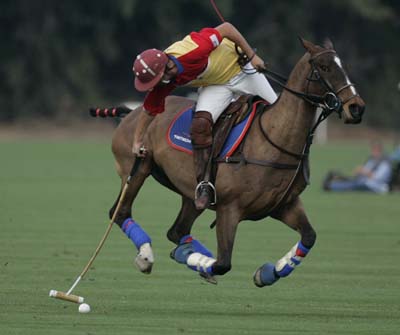
So as you are hitting the ball and your horse drifts either a little too far away or too close, guess what will allow you to make that adjustment, if you and your horse have been working on leg yielding or lateral movement.
You are trying to win that ride-off. What do you think is more effective? Using your hands only and steering towards your opponent, or using your hands and outside leg together to get your horse’s body into that ride-off.
When you and your horses are communicating well through the combination of your hands and legs, you are able to get to many more plays, more effectively.
You are turning to the right and your horse is leaning too much into the turn and too close to the ball. You steady with your reins and squeeze with your right leg and the horse adjusts their frame more around your leg and off the ball a tad. That allows a safer more balanced turn and a better opportunity to make a play on the ball.
I will admit, we have entered the world of brussel sprouts and tedious detail when we go deeper into equitation like this, but it is what separates those that move around the field as part of their horse to those who ride around simply on top of their horse.
And there is nothing wrong with riding on top of a horse, you are not alone, or rather, they are not alone. However, you must also accept the fact that simply riding on top of one’s horse increases your odds of winding up underneath your horse more often. There are other factors at work, such as gravity, but that is another subject that you can find additional info on if you just do a google search-type in Sir Isaac Newton.
Happy Polo !!