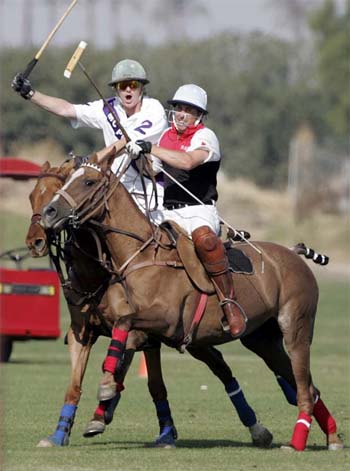
 Tip 42: Taking the Danger Out of “Taking Your Man.” When I think of all my great experiences in our awesome game of polo, there is one area that I believe we need to focus our attention on for the improved safety of both rider and horse: The Ride-off.
This one aspect of the game seems to come up as the common denominator in most of the accidents involving serious injury.
I realize that there is an acceptable level of risk to be associated with anything that provides the motion thrills similar to polo. However, when you step on a roller-coaster, you are pretty well assured that you will remain on the tracks throughout the ride and no one is going to ride up alongside of you and purposely try to toss you off your cart. I believe that we can make some important adjustments that will significantly reduce the incidence of serious injury, without lessening the caliber of play. In fact, I think the results of these changes will promote the characteristics of the game that are far more representative of true skill on the part of the players. It is the lesser skilled players that are always assigned the task of eliminating a higher rated mallet from the opposition.
If you read the rule that deals with the ride-off, you will already see that the USPA has put a lot of thought behind the correct procedure for riding-off. And there is quite a list of factors that the umpires are supposed to be considering, including size of the mounts, awareness, and fatigue of the horse.
I encourage you to consider these suggestions:
I feel we need to re-address the rule associated with riding-off another player and put in even stronger language. I suggest an International campaign to address this very serious problem of misjudgment of the factors involved in riding another player off. It is to the safety of our membership that we might consider replacing some of the ooos and ahhhsss on the sidelines with more whistles on the field of play.
The seven thoughts to ride by, while riding-off.
1) First you must come parallel to another player prior to the ride-off or any contact !
2) You must adjust your speed to the player you attend to make contact with.
3) Then the angle is determined by the speed. If you are at a full run, very little angle is necessary. If you are at slower speeds, a greater angle is acceptable.
4) You can not be any more than six inches in front or behind the opponents’ leg when you actually make contact.
5) Once you make contact, you must continue to match the speed of the opponents’ horse.
6) If you choose to disengage from the opponent, you should move away laterally, and then continue forward. Or if you are losing the ride-off-pull away laterally from the other mount as they accelerate.
7) Any bump that even causes a horse to lose their balance, even for a single stride should be strictly penalized. If a bad bump is not penalized, what would stop a player from possibly putting on even a little more angle on the next attempt?
Simply stated, I am suggesting reducing the angle at top speeds to just a few degrees.
I would encourage more responsibility on the rider in front to take care of the rider behind if you disengage or pull away.
In teaching and coaching polo most of us have stressed the importance of taking the man defensively, perhaps more so then any other single aspect of the game.
There is one factor that is far more important than taking a man, and that is a player’s safety. So I offer “Field Awareness” as the primary focus, as our daily mantra. Another common coached tidbit of misinformation is “turn away from your back-shots”. I would suggest looking first before we turn in any direction is a far healthier and more productive option. Sometimes it is a better play to continue in the same direction after a back-hander, or possibly even turning over the line….if no one is coming from behind. Once we focus on any single aspect of the game, we lose focus of the field, of our Field Awareness. Losing focus of the field has and will continue to cause serious accidents. Some of the worst wrecks have been between teammates going to the same play!! Their focus was the ball as opposed to the field.
Badly timed bumps (horses legs getting tangled) and bumps with too much angle have been responsible for a number of serious injuries and one death that I am personally aware of.
Field Awareness is no different from Driving Defensively. The good drivers are aware of all of the traffic around them and ahead of them. They stay alert to unexpected and sometimes even illegal moves of the other cars around them. They drive, leaving themselves an “out” if there were another collision close to their own proximity. We are taught to drive with “Field Awareness”. Anytime we place full focus on cell phones, pda’s, i-pods, friends, or kids in the back-seat, we lose our field awareness on the freeway. Some states have outlawed the use of hand held phones altogether. When you are on the polo field, and your entire focus is on riding off a player, you might as well be on your cell phone looking up a name in your contact file. I am calling for a higher level of field awareness in each moment of every chukker. I believe that every player can benefit from this information, even if there are no rule adjustments to address the problem. If you ride with this information, you might possibly lose a play here and there, but you may just save a life, perhaps your own. Here’s wishing you many decades of the greatest game on this planet !!