 Tip 43: So . . .you say you can’t get it up?
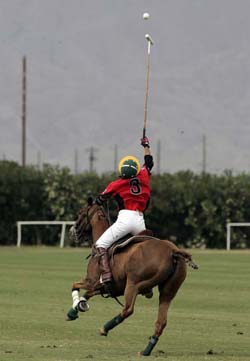
To get the ball in the air, you have to have the proper follow through. Here are Steps 4 & 5 to add to 1-2-3 from article #1. Follow through determines loft and accuracy….two pretty important aspects of our shots.
My very first weekly tip on PoloBARN was an article about a simple exercise of 1-2-3 to tune up your swing. Quick review:
1 is proper preparation with your shoulders
2 is rotating your hips and shoulders through your swing while brushing the playing surface with the head of your mallet, low in your leg.
3 is finishing with your mallet head in the direction you want your shot to go
In polo and tennis, you need to be able to angle your shots from any position to any position if you are a top ranked player, whereas in golf, you are normally allowed to re-position your feet in the direction you would like to have the ball go. If….we allow our mallet head to always close immediately after we make contact with the ball on the forehanders, the ball will pull left on our off-side and pull right on our nearside. Same result with the backhanders. That is because we are actually allowing the mallet head to turn counter clockwise on the offside fore and clockwise on our nearside-fore as the ball leaves the mallet. There are some who say that this natural hand rotation is a good thing. My position is that if you do this too early, while your mallet and ball are still in contact with each other, the direction of the ball will be determined by the rotation of your hand. I have had a good deal of success in my own accuracy, as well as helping many others by keeping the focus on the mallet head being properly positioned at the finish of the swing.
I now offer you steps #4 & #5.
#4-Keep your head down and make certain your eyes follow the cane
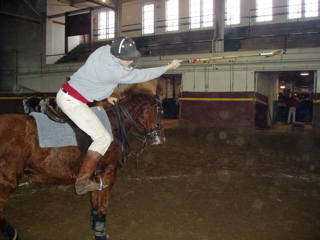
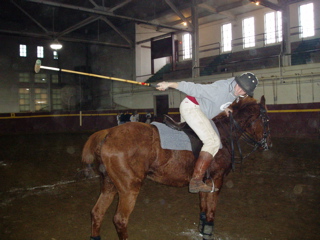
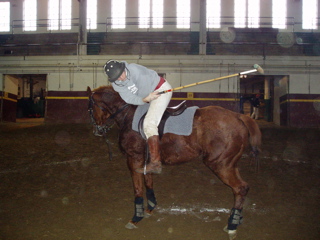
As in tennis and golf, we need to keep our head, and therefore our shoulders down as we finish our swing. Your eyes must follow the cane/shaft through the swing. The majority of players in polo finish their swings with their head and eyes up above their follow-through and high in the saddle. Interestingly enough, the majority of players are also handicapped at 2 and lower. For years, I had very good backhanders and average forehanders on a professional level. I had pretty good accuracy with my forehanders but lacked the distance. So my #3 was ok, but #4 was weak.
The reason. On my backhanders, my eyes followed the cane. I dropped my shoulders forward as I turned them through my shot, and my head was below the cane on my follow-through. Not so on my forehanders. It was not until very late in my career that a friend noticed I was not doing so on my forehanders. When I placed my focus on dropping my head more and following the cane, bingo. The loft and distance were now in place. A very famous gentleman by the name of Daniel Gonzalez (former 10 goaler and father of Mariano Gonzalez) had helped me one season in Santa Barbara with my knock-ins. I was able to get a long ball on the knock-n after his guidance, but still struggled at speed. Why? At speed I reverted back to what felt right to me, my well-established old habits. So 4, just as in golf, is huge…no wait a minute…HUGE !!
#5-Now…here comes the dangerous part
To get good snap through the ball, we need to do two things. One…we rotate our shoulders and hip through the ball. Two…and here’s the dangerous part…we have to speed up our swing a tad by putting some pressure on the grip with our hand as we swing towards the ball. This will speed up the swing just a tad so that the mallet will snap through the ball just ahead of our arm and shoulders. This snap is why we like mallets to have a little whip down low in the cane. This snap will accelerate the head and give more power and lift in your shots.
So why is everyone telling me I swing too hard or fast? Because most of us do. We swing hard with our arm…way too hard…and have very little body rotation, which along with the horse is the real source of the power. So even the mere mention of #5, to speed up your swing is very dangerous to share. There is the great possibility that your swing may revert right back to what you were doing wrong in the first place. If speeding up your swing causes you to come up with your head and shoulders, then you are not yet ready for #5. #5 is only for those who are now disciplined with steps 1-2-3-and 4. If 5 cause 3 & 4 to disappear, then forget 5 for now. 3 & 4 are way more important.
It would be of great help to have your swings on video. Just have someone video your swings during stick and ball and in a game. (often our stick and ball swing and our game swing are two different swings. Why? Two words: speed and speed. Well, sometimes there is that nervous thing…so maybe three words. We need to start earlier than we think we need to start at speed…..but that is another article (but start earlier at speed…sounds pretty darn simple doesn’t it…faster…earlier).
As you review your swings, are all the steps in place 1-2-3-4-5.
1) Preparation
2) Rotation of your body through the swing and down low enough in your leg to be under the ball.
3) Follow-through and finish with whichever stroke you are executing
Position of mallethead on the follow-through
4) Head and eyes following cane
5) Speed up mallet head a tad as you begin swing
I put 5 last as 1-4 need to be in place first.
I wish you greater distance, loft, and accuracy, with far less effort. Happy Polo !!