 Tip 44: Turning the Ball - All players should know how to properly turn the ball, even if only to better understand what the opponents may be capable of doing. You may not be comfortable with turning the ball yourself at this point in time, but you should practice turning the ball when you are stick and balling. If you are unfamiliar with the term, “stick & balling”…just back the ball. Being able to turn the ball if there is no opponent pushing you on a back shot can be a very effective play. To turn the ball properly you must consider the following:
-The current line of the ball
-Location of opponents and their proximity to the right of way
-The handling ability of your horse
-Field conditions
-Your ability
-Where do you want to be heading as you complete the turn.
So you know you are not being pushed. You decide you are going to turn the ball, normally on your offside to the right. However, with a good deal of practice, turning the ball left while on your off-side is a very effective way to get back into an offensive direction with your offside protected from a hook. However, turning left with the ball on your offside is very challenging. You will also see the better players able to turn the ball on their nearside, normally to their left. If they have an opponent riding them on their offside, they may remain on their nearside as they turn, but usually they are hoping to start on their nearside while turning left and eventually get back to the ball on their offside. So it is the goal of a complete player to be able to turn in both directions from both sides, but it is best to start to the right, with the ball on your offside. It is important to turn the ball as quickly as possible. A long series of shots at slight angles across the field increases the probability of losing the ball to an opponent or just missing it altogether. In addition, you are making very little, if any progress back up field, and you are using up a lot of your horse’s energy going across field.
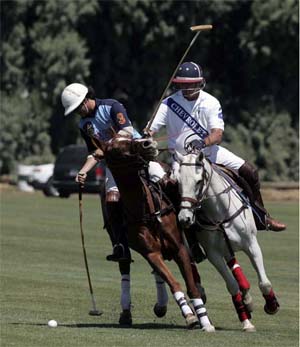
To turn the ball effectively, it is best to start at a trot or slow canter on the practice field. Learn to address the ball on the line of the ball, either cut the ball away from you with a short offside forehander, or flip the ball away with a short “reverse” under-the neck-shot with the toe of the mallet forward. Once you turn the direction of the ball, you then turn the direction of your horse onto the new line. Too many players turn their horse first and then the ball....which is usually followed by either the sound of a whistle, and/or players screaming “look out”, or both. By the way…how does one scream “look out” in Spanish? I think it is something like ”Cuidado !!”. I’m not positive what the sometimes attatched phrase of “gringo boludo” is all about, but the high-pitched Latin screaming part should be enough of a warning. Remember that you are normally only going to use this play if no one is pushing you. If players are running up behind you, the novice-intermediate players should just back the ball. If you turn the ball with players following hard behind you, you could learn why not to the way I did…you know…the hard way…the way I like to learn most things. Instead of following the wise guidance offered to me as a younger player by the local sage, now being offered to you in this article, I had to be run over by two horses behind me at a full gallop. Three horses and three players all playing “leap frog” at speed, resulting in summersaults and rolls across the turf, miraculously, no ponies or people were hurt. Even though it was a highly effective lesson for me at that time, I wouldn’t advise trying it at home……...away….…or anywhere else on this planet.
Get familiar with handling the ball right and left on the practice field at slower speeds, before you ever consider trying it in a scrimmage or match. You will find that when you turn the ball right on your offside, your horse leans into the right so you stay a little farther from the ball, same on your nearside turning left. However, when you turn left with the ball on your right, your horse is leaning away from the ball, so you must stay closer to the ball. Normally, you dribble the ball with the ball ahead of your stirrup, alongside the neck of your horse. As you lean out to dribble, you will have to hold your horse a tad with the reins and counterbalance in your stirrups, because if you lean to hard into one stirrup, your horse will move into that direction and wind up going over the top of the ball. The more advance players learn to dribble the ball almost anywhere, to be able to avoid their opponents, but if you dribble at your stirrup or behind your stirrup, you are more apt to lose the ball. If you are able to dribble effectively, you can be a hero. If you tend to lose the ball more than you hit the ball, you may be best to focus more on back shots. But to always back the ball to no one, isn’t any better than someone who turns it when they should have backed it. The complete player can do either and more importantly, knows when to do which. Sometimes a player will turn the ball in order to allow their teammates to get into better position, and then drive the ball downfield. And as I stated earlier, you may not yet know how to turn the ball, but at the very least, you should be aware of the play to better mark your opponent on the field. In any event, when in doubt, just back that little round thing. And then, don’t turn away from your back shot…go straight as you back it, then….. look….look….look…and then you will know whether you need to turn away…or maybe even stay right where you are…depending on the evolving play. If you don’t look before you turn, you may want to start practicing your summersaults with your kids, in the safety of one of the carpeted rooms in your house, without the horses. I guess you could also get some practice time in the jump toy at the local Chucky Cheeses, even though I think there is an age limit. Happy Polo !!