 Tip 45: “Steady Hold” vs. “Pull & Release”
Where are the brakes on this thing and do I apply steady pressure or tap on the pedal…..uhhh…stirrup ? The few of us left that pre-date the ABS breaking systems will remember our dads and moms coaching us to tap on the brakes so that we didn’t lock them up and go into a skid. The new ABS system now allows us to just apply pressure and hopefully the computers do the rest for us. Unfortunately, most horses have not been equipped with that ABS system and tend to be more responsive to the give and take method of checking or pulling to slow or stop.
It is true that some softer mouth horses will tolerate an easy steady pull when checking or stopping, but even they will still respond well to the pull and release system. The challenge is that there are a great number of horses that will not respond well to a steady pull. There are several problem categories as to horse types with a steady pull approach.
1) The horse that very sensitive, shakes their head some, and may even have a tendency to leap. A steady pull on this type may result in serious injury to you. Horses of this category will not take kindly to a steady pull, as they are overly sensitive. A steady pull will either exacerbate the head shaking or leaping…or worse still, may even move into rearing, flipping over, or bolting.
2) This horse feels a steady pull and will match your bet and raise the ante. If you haven’t already figured this out, their steady pull is far greater than ours. Not even daily trips to the gym for weight training will even put you in contention for winning a tug of war with that 900 pounds of horse below you. Not even our friend “Rocky Balboa” was able to go 15 rounds with a polo pony.
3) This horse has responded to the steady pull technique by learning to over-flex. Simple stated, they bury their chin into their neck and have now successfully learned a new trick to get away from any direction from you. Often times, it is said that draw reins and gags, due to their leverage pulley system will promote over-flexion as opposed to pelhams and straight reins. There is some truth to this statement, but I feel the larger culprits are the hands that are holding the reins in the first place.
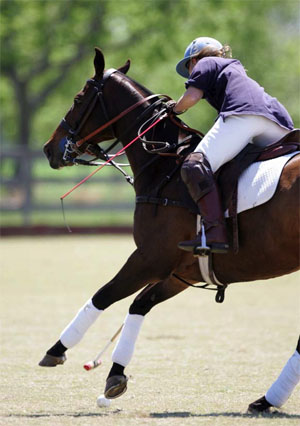
I support the give and take position due to both my direct experience and observation of many great riders in a number of different disciplines. I have always used the analogy of a relationship. A steady pull or all take and no give is usually a recipe of disaster. They say that to balance the old checkbook, we need to make deposits as well as withdrawals. Well, in the horse world, giving some rein is normally considered a reward to the horse, which defines itself as a deposit. Now giving rein doesn’t necessarily mean loosening your reins or riding with longer reins. It means to move your hands forward and back with the action of the horse’s natural head movement.
Another good analogy is fishing. When you get the big one on the line, you need to understand the art of when to give out line, and when to draw in. To date, my “big fishing experience” is a two pound tuna off the coast of Hawaii….ok maybe one pound…but that is another story that I do not care to share at this time. And I am not embarrassed that everyone else was catching 6-8 foot marlins. I kind of like tuna fish….sandwiches. Try to fit a six-foot marlin in-between a couple of slices of sourdough. In any event, if you give a little rein, the horse tends to relax a tad and allows you a better opportunity to take back again. If you understand the natural movement of the canter and gallop, it is a rocking type of motion as to where the horse drives from the back and pushes to the front. As they gather their legs underneath them for the next stride, their head will come back up slightly. This is the perfect time to ask them to check, as they are already in the part of the stride where they are getting underneath themselves. If you pull in the extension part of the cycle, you are pulling against their power that they are using to transfer their weight from their hindquarters to their forequarters. Now…a good soft mouthed horse will probably respond well to your rein pressure in either the collection or extended portion of their stride. I am just presenting at what point of the stride is too our advantage, which is especially important on more difficult horses. You probably already know that horses are pretty much priced at their stopping and handling ability at speed and how long they are able to continue to perform well through the seven or even possibly fourteen-minute duration. Most higher goal horses are not used for more than a chukker a game unless it is a very important tournament. Some horses only go a few minutes at any one time, depending on a multitude of variables.
Now some riders, as I have already presented in other articles, require a horse that is tolerant of somewhat of a steady pull, as they are looking for a little of their own support from the horse’s mouth. Now….that is not a good thing. We are supposed to find our balance from our seat and legs, not our hands. However, realistically, newer riders are going to look for some additional support from the reins and should be equipped with horses that tolerate that. This is one of the very clear examples where a green rider and a highly tuned horse is a very bad color combination. I will insert the original color clash of a green rider and a green horse. It works in clothing, but never in riding. I know some of us want to play the part of the horse whisperer, but take it from me, first hand, Robert Redford, as charismatic and incredibly talented as he is, is an actor, not a horse whisperer. Learning this game of polo is both incredibly fun, as well as a monster challenge. So choose the realistic level of horse for your present ability. It is better to go slow and reach the finish line together, than for your horse to finish first….without you.
So I wish you give and take relationships with your horses…and more importantly…with all of those around you. Happy Polo!!